
The definition of health that most of us grew up with, and with which most medical practitioners still agree, is that “health is the absence of symptoms and diseases.” (1) However, this definition is inadequate if we aim to find true health.
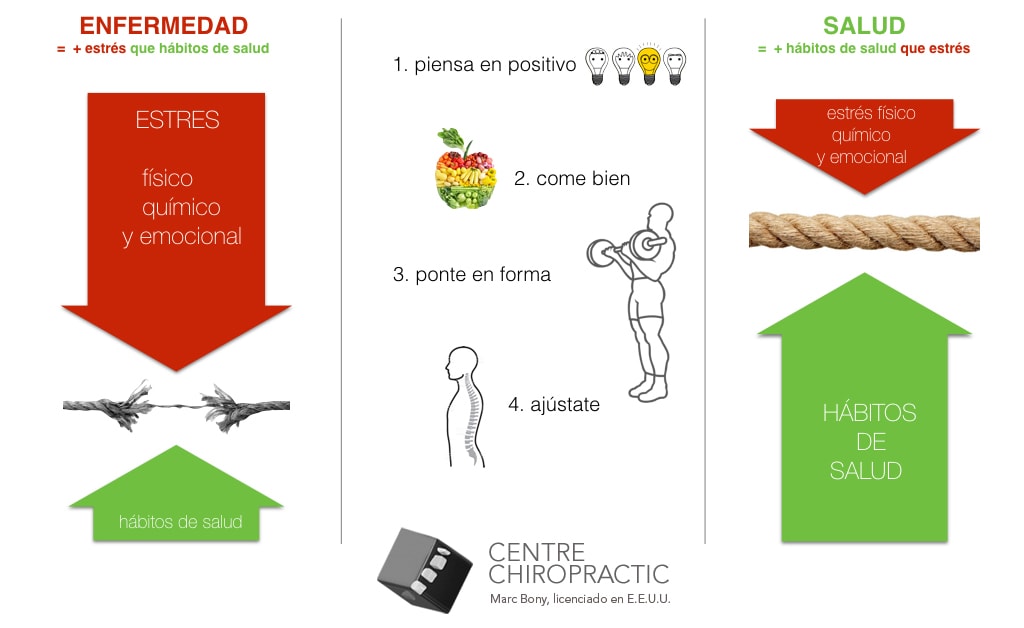
A more constructive way of thinking would be to say that the level of health is determined by “the body’s ability to accurately interpret and adapt to the stresses from the surrounding environment.” (2) At all times, innate intelligence is coordinating thousands of processes to adapt to the environment and maintain balance.
A good example can be found in body temperature. Normally, body temperature hovers around 36.7º whether it is a hot summer day or a cold winter evening. (3) To maintain balance, the body’s nervous system will increase the mechanisms responsible for dissipating heat (for example: sweating) in summer, or conserving heat (for example: blood moves more towards the periphery) in winter. This is a normal response of the body.
Another example is the body’s response when we eat sugar. The moment our tongue touches sugar, various messages are sent to the pancreas through the nervous system, and it begins to secrete insulin into the bloodstream so that the body can properly metabolize the sugar. When this process fails (for example: when the pancreas secretes an insufficient amount of insulin), the person suffers from a form of diabetes.
Does being healthy mean feeling good all the time?
Many of the adaptation processes that occur in the body are not comfortable at the moment, and it may be tempting to try to block or mask them to feel more comfortable. (4)
However, by adopting a chiropractic lifestyle, you will begin a journey towards health that will require you to reevaluate what it means for you to be healthy as well as your way of reacting to certain symptoms.
For example, if you ate something expired, you would likely wake up the next day with vomiting and diarrhea. You might then decide to take some medication to stop the vomiting and also stay home all day.
But, are you sick when your body is adapting incorrectly, or is it a healthy response given the circumstances?
Based on our new definition of health, you would be in this case PERFECTLY HEALTHY. Your body would be demonstrating good health by reacting this way to your environment, eliminating the toxins you ingested the night before. Isn’t it better for your body to get rid of such toxins?
Unfortunately, we have grown up believing that being uncomfortable, as is the case with many symptoms, is a typical side effect of illness. However, both science and chiropractors suggest not to be so quick to judge symptoms as good or bad. There are many negative effects from trying to eliminate or mask what could constitute an important adaptive response, as we will see next.
In conclusion, the extent to which the body’s response is healthy is a product of its ability to interpret and then respond correctly to environmental stresses.
As Nobel Prize winner Hans Selye said:
“The secret of health and happiness lies in the body’s ability to adapt and change in accordance with its environment. Many common diseases occur in most cases due to errors in our ability to adapt. Many nervous and emotional discomforts, high blood pressure, ulcers, allergies, cardiovascular problems, and sexual disorders appear to be diseases of poor adaptation.”
Sources: What is health?
(1) St. Claire L, Watkins CJ, Billinghurst B. Differences in meanings of health: an exploratory study of general practitioners and their patients. Family Practice 1996; 13:511-6.
(2) Selye H. The Stress of Life – Revisited Edition. Mcgraw- Hill Book Co., New York. 1978.
(3) Mackowiak PA, Bartlett JG, Borden EC. Concepts of Fever: Recent Advances and Lingering Dogma. Clin Inf Dis 1997;25:119-38.
(4) Nesse RM, Williams GC. Why we get sick-The New Science of Darwinian Medicine. Random House, New York. 1995. pp 35-6