Discover how foods rich in folate can improve your health and prevent deficiencies. Learn which…
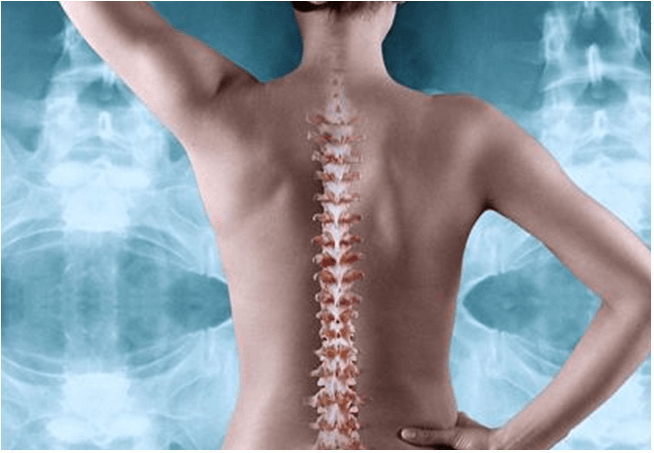
Osteoarthritis spinal degeneration process
Osteoarthritis spinal degeneration process
Shortly after the discovery of X-rays, chiropractors began to use this tool in the examination and care of the spine.
In addition to revealing the presence or absence of the proper curves in the spine, the lateral view of the spine can more easily show the long-term effects of an uncorrected spinal trauma (degenerative osteoarthritis).
The process
This process in the spine has similarities to dental caries, as it generally manifests due to neglect. Furthermore, like dental caries, it can happen to anyone, regardless of age.
Because it is often observed in older people, many believe it is simply the normal aging process. However, this progressive worsening, this degenerative disease (osteoarthritis) is the result of not correcting vertebral misalignment, and is rather one of the ways the body reacts to physical, emotional, and chemical stress.
Four phases in the osteoarthritis process
Spinal degeneration is a process. Using the four-phase model based on the book “Managing Low Back Pain” by W.H. Kirkaldly-Willis and Thomas Bernard, Jr., along with the book “Anatomical-Roentgenographic Studies of the Spine” by Lee A. Hadley, M.D, we can accurately show our patients the different phases of the osteoarthritis process.
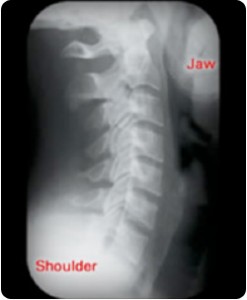 Normal Curvature.
Although this process can occur anywhere in the spine, it is easier to see in the cervical spine (neck osteoarthritis).
The photo shows how the neck should look from a lateral angle, that is, viewed from the side, the neck should have a elegant curvature forward.
The edges of each bone are well defined. There should be the same disc space between each bone and the openings of the nerve roots should be clear and unobstructed.
Phase 1  Due to physical stress on the spine or body, in this first phase we can observe a loss of curvature.
The 7 cervical vertebrae of the neck should have a curvature, because it is thanks to it that the weight of the head is cushioned over the rest of the spine. We will see changes in the following phases, resulting from an increase in weight on the vertebrae, which will try to become stronger.
Left untreated, this phase will progress to the next.
See the drawing: The affected bones have lost their individuality and their ability to move.
Phase 2  If neglected, in the second phase, the joint surfaces lose their clearly defined edges as the first signs of bone spurs become visible on X-ray views.
Some believe that the body detects the accompanying inflammation as a signal of a broken bone.
The process of calcium salt deposition begins. Without being in a mold to prevent movement, fusion does not occur. Left untreated, this phase will progress to the next.
See the drawing: The bones appear to be closing over the discs, and the soft tissues (nerves) are affected with possible irreversible injuries.
Phase 3  If not corrected, the problem worsens in Phase Three. Surprisingly, pain and other evident symptoms may still not appear. For this reason, the presence of osteoarthritis is often questioned. In fact, many people say things like: “I was fine until last week when I bent down to tie my shoes.” However, this is not what the X-rays show! since osteoarthritis has been there for over 30 years.
The body could “successfully repair the worn bone.” However, through chiropractic adjustments.
See in the drawing: The bones appear fused and do not allow soft tissues to exit through the intervertebral holes.
 Phase 4 If the patient waits to reach this phase, there will be little to do, as the message from the brain-body will have already been blocked and therefore it is possible that it has caused the death of some organ that in the best case will lead to a transplant or in many other cases will lead to the death of the entire organism, depending on the affected organ.
Phase 4 is not included in manuals because at these levels little can be done.
The prognosis
Some members of the practice who began chiropractic care in Phase One have discovered a restoration of their spinal curves and an improvement in their range of motion. Success in members of the practice who are in Phase Two is less predictable and depends on many factors.
Although little can be done after decades of neglect in cases of Phase Three and four, we focus our attention on those areas of the spine that have not yet been lost in the osteoarthritis process.
It is impossible to predict the effect that chiropractic care will have in your case in slowing down, stopping, or reversing this process. A particular phase cannot be used to determine the amount of care that will be necessary. But in all cases, we will observe a great level of improvement and over time of care we will be able to determine the optimal correction time more precisely.
Marc Bony,DC
Call your nearest chiropractor to avoid entering the unwanted osteoarthritis process. The Spanish Association of Chiropractors will provide you with the closest one to your home.
Marc Bony,DC
Related Posts