Chiropractic can be an effective and natural solution to relieve colic in babies. Learn how…
Excess Sugar and Its Relationship with Liver Cancer

At the Marc Bony Chiropractic Center in Mataró, we explore how excess sugar is linked to liver cancer. Learn how to prevent it through natural health.
Excess Sugar, Chemicals, and Liver Cancer
Worldwide, hepatocellular carcinoma (HCC) of liver cancer is the second leading cause of cancer death due to its high prevalence and treatment difficulty. Researchers warn that by 2030, the global rate of liver cancer will double, affecting more than 1.2 million people. Alcohol-induced cirrhosis and NAFLD (non-alcoholic fatty liver disease) can be reversible in their early stages if you quit alcohol and reduce your intake of processed fructose, respectively. Non-alcoholic fatty liver disease (NAFLD) is becoming increasingly common. Between 2001 and 2013, the number of diagnosed cirrhosis cases nearly doubled, and deaths from cirrhosis increased by 65% between 1999 and 2016. The largest increase (10.5%) was recorded among ages 25 to 34, where alcoholic cirrhosis has increased dramatically.
Excessive Sugar Consumption Drives Rising NAFLD Rates (Excess Sugar)
While alcohol-related cirrhosis is increasing mortality rates, the growing prevalence of NAFLD is contributing to the overall burden of liver diseases. In the case of NAFLD, fatty liver occurs in the absence of significant alcohol consumption and is instead driven by excess sugar, now even found in young children. NAFLD is often asymptomatic, though it can cause fatigue, jaundice, swelling in the legs and abdomen, mental confusion, and more. If untreated, it can cause liver inflammation, called non-alcoholic steatohepatitis (NASH), and can lead to liver cancer or liver failure. However, just as with alcohol-related cirrhosis, NAFLD can be reversed in its early stages by maintaining a proper diet and exercising. Most importantly, you must eliminate processed fructose and other added sugars from your diet. Fructose affects your liver in ways very similar to alcohol. Unlike glucose, which can be used by practically all cells in your body, fructose can only be metabolized by the liver as it is the only organ that has the transporter for it. Since all fructose is transported to your liver, if consumed in large amounts, it ends up damaging and deteriorating this organ in the same way alcohol and other toxins do. Additionally, the way your liver metabolizes fructose is very similar to alcohol, as both substances serve as substrates for converting carbohydrates into fat, promoting insulin resistance, dyslipidemia (abnormal levels of fat in the bloodstream), and fatty liver. Moreover, fructose undergoes the Maillard reaction with proteins, leading to the formation of superoxide free radicals that can cause liver inflammation similar to acetaldehyde, an intermediate metabolite of ethanol. According to Dr. Robert Lustig, a neuroendocrinologist in the endocrinology division at the University of California, fructose is a “chronic and intrinsic liver toxin,” meaning dose-dependent.
Excess Glucose Converts to Fructose and Depletes Your NAD+ (Excess Sugar)
The problem is not only consuming excessive fructose in processed foods, but ultimately and in an effort to metabolize glucose, excess glucose converts to fructose for energy. Let me explain this in more detail. When your body is exposed to chronic excess glucose, the first enzyme that breaks it down is hexokinase, and when this enzyme is saturated, it can no longer break it down. Once this occurs, glucose will be metabolized through the polyol pathway, where aldose reductase metabolizes glucose into sorbitol and sorbitol dehydrogenase subsequently metabolizes sorbitol into fructose (see the diagram below). 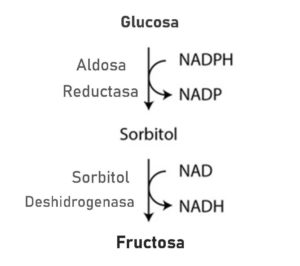 It is estimated that when you are in good health, only 3% of glucose passes through the exposed pathway, but at least 30% flows through this pathway in chronic hyperglycemia, creating a vicious cycle of excess fructose. This metabolic catastrophe is a redox reaction derived from the exchange of one molecule of NADPH for one of NADH. This is precisely what should not happen, as NADPH is used as a reserve reducer for your antioxidants and is necessary to produce both your steroid hormones and your fats. When your levels are low, you will start to experience severe difficulties. To top it off, it increases your NADH index and worsens your NAD to NADH ratio. As the fuel supply exceeds metabolic demand, mitochondrial and cytoplasmic NAD to NADH ratios decrease. The resulting hyperpolarization of the mitochondrial membrane perpetuates electron leakage and excessive oxidative stress. Fortunately, there is a simple and affordable solution that should radically improve this metabolic catastrophe. The first thing you should do, invariably, is to clean up your diet as we have repeatedly advised, so your body can burn
Related Posts