In a world where multinationals dominate the healthcare landscape, the focus on natural health and…
Cholesterol: The Creation of a Myth!

How is a myth created?
I don’t know if you have heard of the phrase by J. Goebbels that says: “A lie repeated properly a thousand times becomes a truth.” And this paradigm is known and used today for various purposes.
In 1954, a researcher named David Kritchevsky published a study on the effects of feeding pure cholesterol to rabbits. What happened was that they ended up inducing atherosclerosis. The big mistake was thinking that that result in rabbits, which are herbivorous beings, could be transferable to humans when the physiology of the latter is completely different. What actually emerged from then on, due to the powerful influence of that study on Ancel Keys, was the construction of a myth. And I say this because there are also countless scientific investigations that demonstrate just the opposite.
Ancel Keys’ population study in the Seven Countries Study published in 1972, studied sixteen populations in a total of seven countries (originally there were six). This study has been used countless times to demonstrate that the consumption of saturated fats raises cholesterol and this is associated with cardiovascular problems.
However, the study is full of biases, errors, and even important information that the researcher did not consider important and was not included in the report. For example, the consumption of saturated fat was the same in Crete and Corfu, but the latter island had sixteen times more cardiovascular disease.
Something similar happened between North Karelia and Turku, both in Finland. If we take as evidence the electrocardiograms that are statistically collected in the study, people with more heart problems tended to eat less saturated fat.
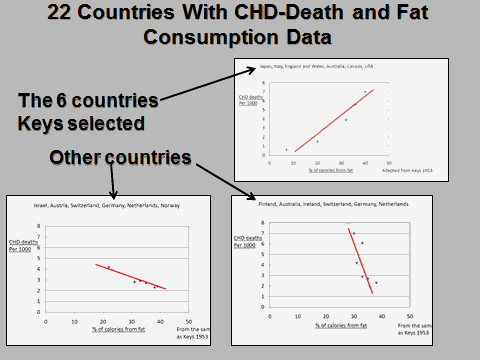
Countries like France or Switzerland were conveniently excluded from the study because both cases refute the hypothesis of cholesterol and saturated fat (France and Switzerland consume a lot of saturated fat and have low cardiovascular disease).
In reality, with the data from the 22 countries available at that time, it was possible to justify anything about the consumption of saturated fat and relate it to cholesterol by selectively choosing some countries and leaving out those that were not of interest. The fraud of this theory seems evident.
The fact that Japanese men living in Japan had low cholesterol and low rates of heart attacks while Japanese men living in California had high cholesterol and high cardiovascular incidence was taken as confirmation of such a hypothesis. Keys considered irrelevant to his conclusions that Japanese Californians with low cholesterol had more heart problems than Japanese Californians with high cholesterol.
- In 1961, Mathur and his collaborators found no link between cholesterol and arterial plaques after analyzing 20 autopsies and more than 200 scientific cases.
- In 1962, Dr. Marek published an article in the American Heart Journal with the same conclusion: there is no correlation between cholesterol and arterial plaque.
- In 1964, surgeon Michael DeBakey, after analyzing a thousand patients during operations, offered the same message: atherosclerosis has nothing to do with the concentration of cholesterol in the blood. In 1964, the Journal American of Medical Association published that the Italian community of Roseto, in Pennsylvania, consumed high amounts of animal fat, for example, they basically cooked with lard, and had a “surprisingly low” level of cardiovascular problems.
Keys, Stamler, and all the followers of the cholesterol and fat hypothesis had no problem rejecting as worthless, irrelevant, or misinterpreted any research that contradicted their findings.
- In the 1980s, with clinical studies, Keys and his followers tried to prove their theory since population studies were not reliable, the LRC study (with a result of after 8 years of follow-up, there was the same cardiovascular mortality among those who reduced their cholesterol with medication and diet and those who did not change their diet or take the medication).
- The MRFIT study had a result similar to the previous one. And the Helsinki Heart Study had a result of 17 deaths among those taking the drug compared to only 8 who did not take the cholesterol-lowering drug. This data was considered insignificant by Keys and his team in the study’s conclusions.
- In the 1990s, Canadian scientists followed nearly 5,000 middle-aged patients for twelve years with the same results stating that there is no relationship between cholesterol and cardiovascular disease.
Just under 1% of humans have much more cholesterol than the rest of us. This is due to a genetic variant called familial or hereditary hypercholesterolemia, and it represents an interesting study group.
- In 2001, a group of Dutch researchers found that in the 19th century, people with this genetic variant lived slightly longer than average and since at that time the most common cause of death was infectious, they concluded that cholesterol somehow protected against viruses and bacteria.
- Indeed, shortly after, another study appeared establishing that low cholesterol was a risk factor for any type of infectious disease. In fact, it is known that people with low cholesterol have a higher risk of mortality from intestinal and pulmonary problems, and a significant portion of these are of infectious origin.
There are constant studies that we can find with the same conclusion stating that there is no relationship between fat consumption and arterial plaque, and below we leave you the sources of the same.
But even so, the low-fat diet and the recommendation of cholesterol pills ended up being politicized. And here we have the creation of the cholesterol myth: that saturated fats have been the usual culprits of cholesterol for decades.
And the myth has been created from the press, public opinion, through repetition, and from government agencies, which often have advisors belonging to the pharmaceutical industry.
We also know that in recent years this alleged guilt is more than questionable, increasingly supporting the idea that it is sugar in particular and refined carbohydrates in general that should bear that bad reputation.
Low-fat diets, which by definition are high in carbohydrates, end up increasing LDL cholesterol (the so-called bad), and what is more concerning is the LDL of the atherogenic type, which are dense and small particles (the real bad), as can be seen in the Current Atherosclerosis Reports from November 2005.
If some clinical studies overlook the relationship between glycemic carbohydrates and LDL cholesterol, it is because they do not discern between these two types of LDL. Contrary to what we are told, having high LDL cholesterol is not bad if they are large particles; the problem arises when they are small.
It is precisely these latter ones that seem to be negatively influenced by the consumption of glycemic carbohydrates. When our diet situation is one of high LDL cholesterol treated with a low-fat diet, it ends up forcing the increase of LDL cholesterol and particularly of the small and dangerous particle type, as is the experience of many cardiologists.
So you are likely to be a consumer of statins to reduce cholesterol. The more rigorously you follow that recommended diet, the greater the likelihood of higher doses of statins.
Your doctor should warn you to take coenzyme Q10 since statins suppress its natural production. And this will lead to fatigue and muscle pain in the medium to long term. In this case, it is unlikely that your doctor has advised you on non-medication solutions to control cholesterol.
Important studies that demonstrate the NO relationship between saturated fats and arterial plaques or cholesterol
https://www.ncbi.nlm.nih.gov/pubmed/19828709
Sources of the studies: https://academic.oup.com/qjmed/article/96/12/927/1533176/High-cholesterol-may-protect-against-infections
http://www.bmj.com/content/322/7293/1019
Canadian Study: https://www.ncbi.nlm.nih.gov/pubmed/2310996
Studies from the years:
60s: https://www.ncbi.nlm.nih.gov/pubmed/14124703
70s: https://www.ncbi.nlm.nih.gov/pmc/articles/PMC1930588/
80s: http://journals.lww.com/jcrjournal/Abstract/1986/11200/Prognostic_Factors_for_Mortality_in_a.4.aspx
90s: https://www.ncbi.nlm.nih.gov/pubmed/8150059
2000s: https://www.ncbi.nlm.nih.gov/pubmed/10690699
Population studies: http://healthimpactnews.com/wp-content/uploads/sites/2/2011/07/22-countries.gif
An evident lie: https://www.youtube.com/watch?v=v8WA5wcaHp4
Related Posts